

Screening For Other Cancers
Prostate Cancer
Prostate cancer is the most common cancer in Singaporean men and the risk increases with age. About 1 in 20 men will be diagnosed with prostate cancer during his lifetime in Singapore. Death from prostate cancer is less common as only some cases will progress to advanced disease.
Find out more about screening for prostate cancer and consult your doctor before you decide if you should screen for it.
Prostate-Specific Antigens (PSA) Test
The PSA test is a blood test that is used to screen for prostate cancer by measuring the level of prostate-specific antigens in blood. Men with prostate cancer usually have higher PSA levels.
However, there are pros and cons to PSA testing.
There are other conditions that cause high PSA levels, and many cancers diagnosed through the PSA test are slow-growing (meaning that they do not need to be treated, and just need to be monitored).
Learn more about PSA testing to decide whether you should get tested
Pros and Cons of a PSA Test
For men who develop fast-growing prostate cancer, PSA testing allows diagnosis at an earlier stage where the cancer is still limited to the prostate. Early diagnosis reduces the chance of cancer spreading to other parts of the body and death.
The majority of men found to have high PSA levels may become anxious after being tested. These men may then undergo a biopsy, only to find out that they do not have cancer.
Many cancers diagnosed through PSA testing are slow-growing and therefore will only require monitoring, which may be stressful for some men.
Should I Go For a PSA Test?
The PSA test is classified as a screening test recommended for men at higher risk. Men aged 50 to 70 or men with strong family history of prostate cancer¹ are at higher risk of prostate cancer.
It is important to discuss with your doctor whether the PSA test is appropriate for you based on your individual risk and symptoms.
¹One or more first-degree relatives (father, brother) diagnosed before age 65.
FAQS
Is prostate cancer related to benign prostatic hypertrophy (BPH)?
No. Prostate cancer is a different disease from benign prostatic hypertrophy (BPH). In BPH, growth of the prostate can affect urine flow but cannot spread to other organs and does not affect lifespan.
Is prostate cancer a dangerous disease?
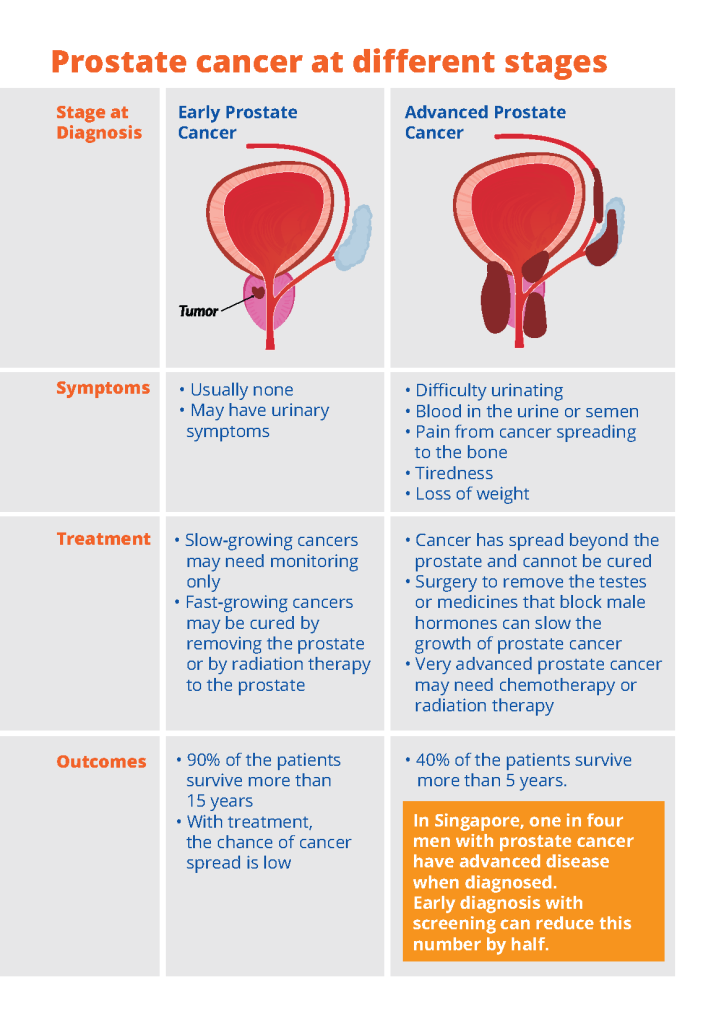
It can be. If you suffer from a fast-growing prostate cancer, the cancer can grow and spread beyond the prostate gland to other organs. Cancer that has spread this way is called metastatic prostate cancer.
But not always. Many prostate cancers are slow-growing tumours that will remain limited to the prostate gland and have no effect on lifespan.
Slow-growing tumours will need close monitoring and may not need treatment.
Is prostate cancer treatable?
Yes! There are many treatments for fast-growing prostate cancer. However, once it has spread beyond the prostate, treatments can control symptoms and reduce further spreading but less likely for a complete cure.
Does prostate cancer have any symptoms?
Not always. Prostate cancer may produce no symptoms at all in early stages. Once the cancer has spread, it can cause serious symptoms.
What is prostate cancer like at different stages?
Does a high PSA test result mean you have prostate cancer?
Not always. Many other conditions of the prostate that are not cancerous can also increase PSA levels such as BPH and infection. If PSA is high, a biopsy test may be required to determine if you have cancer.
During a prostate biopsy, a fine needle is used to remove small samples from the prostate gland and then examined for cancer. There are risks of complications such as pain, blood in the urine, infection and temporary difficulty in passing urine.

